
Microsoft Code Red Highlights Cloud Security Flaws in Crypto
Microsoft has declared a Code Red following a global outage, highlighting deep vulnerabilities and centralized cloud dependencies within the cryptocurrency sector and major exchanges like Coinbase.


- Microsoft has reportedly declared a “Code Red” to overhaul its crisis response and engineering practices following a global outage on November 12-13 that persisted for roughly 24 hours.
- An AWS cooling failure led to Coinbase’s May outage because all five matching engine nodes were housed in the same building, causing three to go offline and interrupting withdrawals, deposits, and trading for approximately eight hours.
- Withdrawing assets from exchanges fails to eliminate dependency on centralized systems because wallets frequently rely on third-party RPC providers rather than a user-operated node.
- The central issue isn’t whether cryptocurrency firms utilize the cloud, but whether dependable alternatives exist during outages as asset migration to blockchains continues.
Microsoft has reportedly initiated a “Code Red” program to revamp its engineering and crisis management after a worldwide service disruption spanned about 24 hours. The cryptocurrency sector, built upon principles of decentralization, has ample reason to take notice.
Internal memos reviewed by Reuters indicate that the technology titan is re-evaluating its methods for handling and preventing major infrastructure breakdowns after the November 12-13 incident affected financial firms, government activities, and corporate operations.
Although crypto markets often market themselves as alternatives to centralized systems, several prominent crypto enterprises rely on the exact same group of cloud computing providers, leaving traders vulnerable to the outcomes.
How A Cooling Failure Brought Coinbase Trading To A Halt
An infrastructure collapse at Coinbase in May highlighted just how fragile access to cryptocurrency markets can unexpectedly become.
Released on June 1, the exchange’s official report pinned the disruption on a cooling system failure housed inside an Amazon Web Services (AWS) data center.
Because all five of Coinbase’s matching engine nodes resided in that exact building, the failure of three nodes left the network lacking the requisite operational capacity.
The platform lacked an automated system capable of transitioning its matching engine over to a separate availability zone.
Recovery efforts hit additional roadblocks due to a simultaneous breakdown affecting AWS’s managed event-streaming framework.
Withdrawals, deposits, and trading suffered major disruptions for about eight hours, while bringing the remaining systems back online required an extra 12 hours or so.
“
“The duration of the outage is unacceptable to us,” Coinbase acknowledged in its subsequent investigation.
Coinbase · June 1 incident report
Such issues were not unprecedented for the company; an AWS disruption back in October 2025 created three hours and 17 minutes of reduced performance for Coinbase users.
Yet, despite these past hurdles, partnerships between cloud services and crypto platforms continue to expand. Coinbase and AWS recently teamed up to integrate x402 payments into CloudFront publishers, embedding blockchain payments directly into legacy web architectures.
The uncomfortable truth remains that underlying blockchains do not have to break for users to lose access to their exchange services.
A decentralized network brings little immediate comfort to someone whose funds remain trapped inside an unreachable exchange.
Your Crypto Wallet May Be Less Decentralized Than You Think
Shifting funds off centralized exchanges mitigates certain threats, but it doesn’t entirely erase reliance on centralized architecture.
Take an Ethereum wallet as an example.
Whenever an individual launches the application to review their balance or execute a transfer, the wallet typically communicates with an Ethereum node via a remote procedure call, or RPC.
This linkage permits the software to fetch network data and broadcast signed transactions.
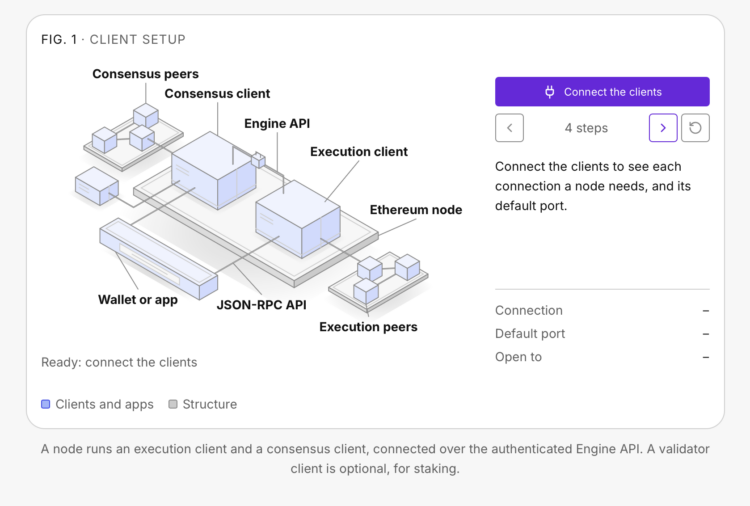
How a wallet app connects to Ethereum through an RPC connection.
Instead of hosting personal nodes, many users depend on infrastructure maintained by third parties. If these providers go down, the wallet may fail to load balances or push transactions, even though the Ethereum blockchain continues to churn out blocks normally.
During an RPC downtime event, funds stay secure on-chain even if the wallet’s standard bridge to the network stalls.
Official Ethereum node documentation itself notes that pervasive dependence on cloud services creates potential single points of failure.
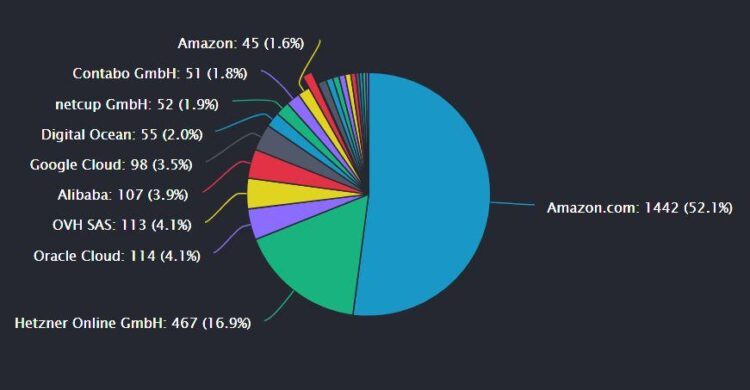
Distribution of Ethereum nodes.
Infrastructure concentration is also highlighted by how Ethereum nodes are distributed. Possessing thousands of independent nodes doesn’t erase collective vulnerabilities if a vast portion utilize the same hosting services.
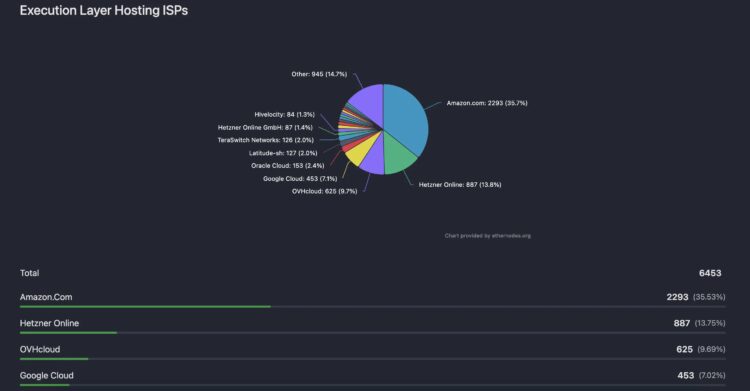
Hosting of Ethereum nodes across providers.
Beyond uptime concerns, shared infrastructure introduces security risks. NewsBTC previously discussed discussions regarding verifier and RPC safety following the KelpDAO exploit, noting that security breach was an intentional exploit rather than a standard cloud failure.
Viable alternatives do exist. Wallet users can toggle to alternative RPC networks or run personal Ethereum nodes, while developers can build applications to seamlessly switch providers if an primary service fails.
However, these choices aren’t always transparent to everyday users opening a mobile wallet application.
In spending years trying to simplify crypto for mainstream adoption by concealing technical mechanics, the industry has occasionally re-established the very dependencies blockchains were meant to eliminate.
Centralization Is Sometimes A Deliberate Engineering Choice
While criticizing crypto platforms for utilizing Microsoft, Google, or Amazon might seem easy, the situation involves complex technical tradeoffs.
Coinbase clarified that keeping its matching engine nodes grouped tightly together was an intentional strategy designed to satisfy market demands for high speed and capacity.
Spreading out these systems introduces network latency, and maintaining redundant setups carries high financial costs, particularly when large volumes of financial data must be synchronized globally.
Major cloud platforms provide extensive operational capabilities and engineering power that smaller digital asset firms would struggle to replicate on their own.
The real issue isn’t that crypto relies on centralized tools, but whether resilient contingencies exist when those services fail.
Following the incident, Coinbase published initiatives to upgrade failover procedures across availability zones and run routine testing in production environments.
Although valuable, drafting a recovery blueprint and successfully enacting it mid-crisis are two entirely different challenges.
What Microsoft’s Code Red Means For Crypto
No definitive proof suggests Microsoft’s recent campaign was triggered by a cryptocurrency network malfunction; instead, the relevance spans a broader scope.
As institutional finance migrates more assets onto distributed ledgers, the dependability of the infrastructure linking investors to these networks grows increasingly critical.
Even if a tokenized fund exists on a decentralized ledger, investors still lean on centralized identity verification, banking integrations, applications, and custody providers to handle their investments.
Similarly, decentralized exchanges execute smart contract trades, but the associated web portals and connection pipelines can create independent points of vulnerability.
Crypto entities should actively prove how their services respond if a preferred hosting provider goes down. Can traders cancel orders or submit transactions? Can backup systems activate without waiting for manual intervention?
Microsoft’s response to its November outage serves as a stark reminder that even tech giants with massive technical capacity can uncover flaws in supposedly stable systems.
The crypto industry doesn’t need to abandon cloud computing, but it must stop using blockchain-level decentralization as a shield to assume all supporting infrastructure is equally resilient.
FAQs
Why did Coinbase experience an outage in May?
Coinbase suffered an eight-hour disruption in trading, deposits, and withdrawals due to a cooling equipment failure at an AWS data center that knocked out three of its five matching engine nodes.
Do crypto wallets eliminate the need for centralized infrastructure?
Not entirely. Even if users move assets off centralized exchanges, mobile and desktop wallets typically communicate with blockchains through third-party RPC providers rather than personal nodes.
Why do crypto companies use centralized cloud providers if they promote decentralization?
Grouping infrastructure tightly together helps exchanges meet high speed and market capacity requirements efficiently, and cloud providers offer operational capabilities that are difficult to build independently.
What did Microsoft’s “Code Red” involve?
Following a global service outage lasting around 24 hours on November 12-13, Microsoft reportedly declared a “Code Red” to overhaul its crisis response and engineering practices.