BlackRock Introduces Tokenized Hong Kong Fund Starting at HK$10
Key takeaways BlackRock has launched its first tokenized money market fund in Asia-Pacific, the HKD Digital Liquidity Fund, for investors in Hong Kong. The tokenized D OnChain class lists a minimum investment of HK$10, against HK$10 million for the conventional I class, but access through stablecoins is reportedly limited to professional investors. The fund gives…


Key takeaways
- BlackRock has launched its first tokenized money market fund in Asia-Pacific, the HKD Digital Liquidity Fund, for investors in Hong Kong.
- The tokenized D OnChain class lists a minimum investment of HK$10, against HK$10 million for the conventional I class, but access through stablecoins is reportedly limited to professional investors.
- The fund gives HKDAP, the Hong Kong dollar stablecoin issued by Anchorpoint Financial, a use beyond payments, while the returns still come from the underlying short-term instruments.
- Tokenization does not remove dealing deadlines or redemption limits, and the disclosures reviewed did not yet give total fund assets or current yields.
BlackRock has debuted its initial tokenized money market fund across the Asia-Pacific region, providing investors based in Hong Kong a novel method to transition capital between traditional assets and blockchain financial vehicles.
Officially named the HKD Digital Liquidity Fund, BlackRock’s tokenized offering accommodates both traditional and tokenized investment units. It additionally establishes a practical application for HKDAP, the Hong Kong dollar stablecoin created by the Standard Chartered-led venture Anchorpoint Financial.
This release follows Anchorpoint’s intentions to introduce HKDAP to Solana, which were made public in late October.
Nevertheless, a notable detail emerges within BlackRock’s product filings. One specific tokenized class features a minimum entry requirement of merely HK$10, whereas stablecoin access is apparently restricted to professional investors.
While innovative technology may increase the accessibility of financial goods, the governing institutions continue to dictate gateway access.
What BlackRock’s New Tokenized Fund Actually Offers
BlackRock confirmed regulatory approval for the fund on September 10, with product listings noting November 16 as the inception date. The commercial rollout was formally reported on Tuesday, November 24.
Unlike numerous investment alternatives found in decentralized finance, BlackRock’s vehicle relies neither on cryptocurrency lending, liquidity pools, nor token rewards to generate yield.
Its underlying strategy centers instead on short-term debt instruments, which include government-backed securities and bank deposits.
Investors secure exposure to these assets through fund units, utilizing blockchain technology to maintain accurate ownership ledgers for the tokenized classes.
BlackRock’s official disclosures outline an initial investment minimum of HK$10 for the D OnChain tier, paired with a 0.31% management fee and daily income distributions.
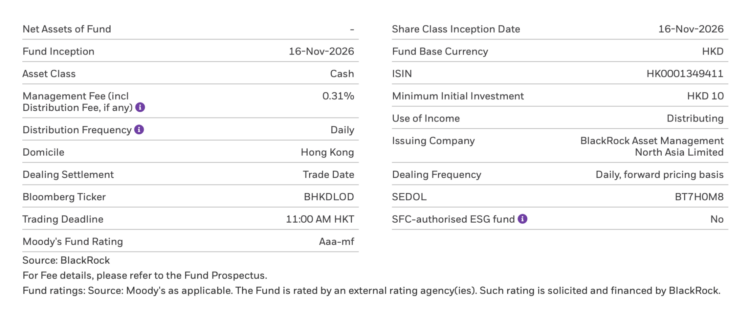
BlackRock product disclosure for the HKD Digital Liquidity Fund. Source: BlackRock.
By comparison, the fund’s traditional I class demands a minimum initial investment of HK$10 million.
While this difference is substantial, a lower minimum threshold must not be confused with unmitigated access, as individual share classes and distribution routes carry unique prerequisites.
A Stablecoin That Can Finally Do More Than Move Money
Perhaps the most compelling aspect of BlackRock’s rollout centers on its implications for HKDAP.
Anchorpoint Financial—a joint undertaking formed by Standard Chartered, Animoca Brands, and HKT—secured its stablecoin issuing license from the Hong Kong Monetary Authority back in April.
Up to this point, conversations surrounding regulated Hong Kong dollar stablecoins have heavily emphasized payments, fund transfers, and underlying roles within broader financial architecture.
The introduction of BlackRock’s fund brings forth an alternative utility. Qualified investors can utilize digital cash denominated in Hong Kong dollars to access investment instruments sharing the same currency denomination.
In its September announcement, BlackRock noted:
“
“Investors will be able to use HKDAP” to subscribe to and redeem investments from the fund.
BlackRock · September announcement
Consider a corporate entity holding HKDAP specifically for routine operational transactions. Instead of leaving surplus funds idle as stablecoins, the firm can allocate excess capital into a money market vehicle, generating returns during periods when the liquidity is unneeded.
Crucially, the stablecoin itself does not generate the underlying fund returns; earnings derive strictly from the underlying short-term financial instruments.
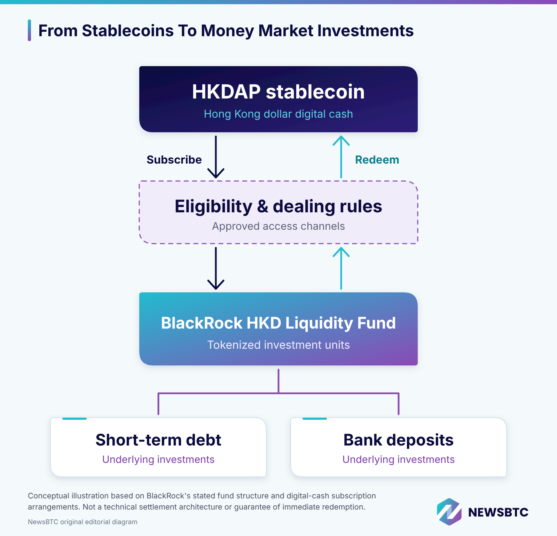
Conceptual illustration based on BlackRock’s stated fund structure and digital-cash subscription arrangements. Not a technical settlement architecture or guarantee of immediate redemption.
For issuers of stablecoins, this integration strategy may ultimately prove more advantageous than simply acquiring another exchange listing by granting businesses a tangible reason to maintain digital cash outside of pure cryptocurrency trading.
The Blockchain Is Always Open. The Fund Isn’t.
A distinct gap remains between the technical capabilities of blockchain infrastructure and the operational framework of BlackRock’s product.
The D OnChain share class operates under a daily dealing schedule featuring an 11 AM trading deadline (Hong Kong time) alongside same-day settlement.
Anyone versed in decentralized finance will note the contrast: a blockchain ledger does not halt transactions simply because a traditional bank closes or a fund cutoff time arrives.
Tokenizing an asset fails to automatically overwrite the established operating hours, liquidity frameworks, or regulatory obligations tied to the underlying fund.
Furthermore, BlackRock cautions that potential technology failures, compromised wallets, or disruptions across blockchain service networks could impair investor access or impede redemption capabilities.
Redemption restrictions remain entirely possible during periods of market stress, and investors continue to face exposure to prospective capital losses.
These constraints do not reflect shortcomings of tokenization itself; rather, institutional participants are bound by reporting, compliance, and custody mandates that cannot be bypassed via smart contracts.
Even so, if users must still contend with traditional intermediaries and strict deadlines, the immediate advantages of tokenization are somewhat diminished.
Hong Kong Is Building The Infrastructure Around Tokenized Finance
Earlier this month, the Hong Kong Monetary Authority scaled up its EnsembleTX settlement initiative to facilitate continuous settlement utilizing tokenized central bank digital money.
This project includes several prominent financial entities, including BlackRock, and supports operations involving tokenized deposits and investment vehicles.
These progressive milestones are steadily bridging components of the financial architecture that formerly functioned in silos.
Regulated digital currencies, tokenized products, and dedicated settlement rail systems are now being constructed to transfer value fluidly among them.
Nevertheless, BlackRock’s latest release underscores why the growth of the tokenization sector should not be judged exclusively by the volume of financial instruments brought onto blockchains.
The more telling metrics will involve the actual capital flowing into these funds via digital cash, the frequency of user reallocations between products, and whether transaction efficiencies scale in cost and speed.
The product disclosures reviewed for this piece did not yet disclose definitive figures for total assets under management or current yields.
Nor does the introduction establish open, permissionless access across decentralized exchanges or external lending protocols.
Such milestones remain critical indicators to watch before concluding that tokenized finance has graduated from institutional domains into general retail use.
Hong Kong has established another core piece of infrastructure; the upcoming challenge lies in driving widespread utilization.
Frequently Asked Questions
What is the BlackRock HKD Digital Liquidity Fund?
It is BlackRock’s first tokenized money market fund in the Asia-Pacific region, designed for investors in Hong Kong to bridge traditional short-term investments with blockchain technology.
What is the minimum investment for the tokenized share class?
The tokenized D OnChain class lists a minimum initial investment of HK$10, compared to HK$10 million for the conventional I class.
How does the HKDAP stablecoin interact with the fund?
Eligible investors can use HKDAP—a Hong Kong dollar stablecoin issued by Anchorpoint Financial—to subscribe to and redeem fund investments, though stablecoin access is limited to professional investors.
Does tokenization mean 24/7 trading and instant liquidity?
No. The fund maintains a daily dealing schedule with an 11 AM Hong Kong time trading deadline, subject to traditional operating hours, settlement rules, and regulatory conditions.