
Wall Street adopts Bitcoin reserves, yet faces a hidden hurdle
CFTC staff guidance allows regulated US derivatives exchanges and clearinghouses to count Bitcoin, Ether, and payment stablecoins toward specific financial resource requirements, subject to valuation haircuts and risk warnings.


- CFTC staff guidance issued on November 23 says swap execution facilities, designated contract markets and clearinghouses may count Bitcoin, Ether and qualifying payment stablecoins toward certain financial resource requirements.
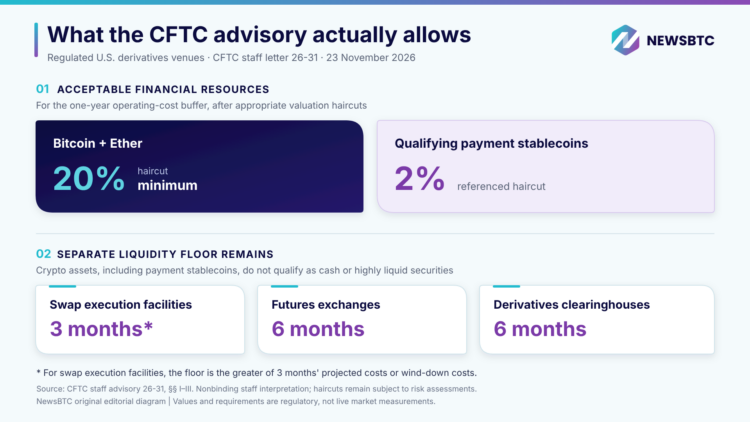
- The advisory references a minimum 20% haircut for Bitcoin and Ethereum, so a $10 million Bitcoin reserve would count as $8 million, and 2% for qualifying payment stablecoins.
- Crypto cannot be used to meet the separate cash and liquid-resources requirement, which covers three months for swap execution facilities and generally six months for the other two types of venue.
- It is a staff advisory, not a binding rule, and nothing in it requires institutions to buy Bitcoin.
Bitcoin reserves have found another potential application within the US financial sector. The Commodity Futures Trading Commission (CFTC) has indicated that regulated derivatives exchanges and clearinghouses are permitted to count Bitcoin, Ethereum and qualifying payment stablecoins toward specific financial resource obligations, though the regulator stops short of treating these holdings as cash equivalents.
Published on November 23, this guidance could grant regulated trading platforms greater flexibility regarding balance sheet management. For investors in Bitcoin, the critical inquiry remains whether this operational flexibility will generate new institutional buying pressure.
That outcome is not nearly as definitive as it might appear at first glance.
CFTC Assigns Bitcoin Reserves a Fresh Function in Markets
The recent CFTC advisory targets three categories of regulated operations: swap execution facilities, designated contract markets and derivatives clearing organizations.
These entities must maintain adequate financial reserves to fund a minimum of one year of operational expenses. Under the new staff advisory, qualifying payment stablecoins, Ether and Bitcoin may satisfy part of those obligations, provided appropriate valuation deductions are applied.
This release follows broader initiatives aimed at incorporating digital assets into traditional financial frameworks. NewsBTC previously covered CFTC directives surrounding tokenized collateral within clearinghouses, highlighting how traditional markets are slowly embracing blockchain-based instruments.
Unlike previous discussions focused on customer trading collateral, this guidance deals directly with the operational assets market organizers use to sustain their everyday business functions.
For firms currently holding Bitcoin, this regulatory clarification enhances the utility of those assets. For enterprises contemplating cryptocurrency integration on their balance sheets, it helps clear up regulatory treatment uncertainties.
However, this recognition comes with a valuation discount.
A $10 Million Bitcoin Reserve Equals $8 Million on Paper
The advisory sets a baseline 20% valuation haircut for Ethereum and Bitcoin, aligning with earlier staff policies governing proprietary crypto holdings maintained by futures commission merchants.
Qualifying payment stablecoins enjoy much more lenient parameters, carrying a specified haircut of just 2%.
Consequently, an exchange with $10 million in Bitcoin can apply a 20% haircut and report $8 million toward its financial resource requirement, assuming no other deductions apply.
The excluded $2 million does not represent an actual financial loss; rather, it functions as a regulatory buffer designed to offset the inherent volatility of digital assets.
Cryptocurrency assets that lack ready marketability and fail to qualify as payment stablecoins generally face a complete 100% haircut, rendering them unusable for these calculations.
Perhaps the most critical portion of the document involves the regulator’s warnings regarding wrong-way risk.
The CFTC staff explicitly notes:
“
A DCM should consider potential wrong-way risk
CFTC staff · November 23 advisory
This hazard is especially pertinent for crypto-centric exchanges. An extended downturn in Bitcoin prices could damage trading revenues while simultaneously diminishing the worth of the reserves required to sustain operations.
The underlying issue is not merely Bitcoin’s volatility, but the risk that asset values could drop precisely when a crypto-focused firm experiences severe financial strain.
Although a 20% discount offers a layer of protection against such conditions, it falls short of a foolproof safeguard.
The CFTC Continues to Differentiate Bitcoin From Cash
Despite allowing digital assets to fulfill broader operational requirements, the agency maintains strict, separate mandates for cash and high-liquidity securities.
Under the terms of the advisory, payment stablecoins, Ethereum and Bitcoin cannot be used to satisfy these specific liquidity obligations.
Swap execution facilities must hold qualifying liquid assets sufficient to cover at least three months of operating expenses or the estimated cost of winding down, whichever is higher.
For designated contract markets and derivatives clearing organizations, operational liquidity thresholds generally mandate covering at least six months.
This distinction is vital because a business can boast significant total assets on its balance sheet while still lacking the ready cash required to settle immediate liabilities.
Furthermore, the guidance omits any mention of whether cryptocurrencies can fulfill separate financial safeguards clearinghouses must hold to manage clearing-member defaults.
Ultimately, the CFTC acknowledges Bitcoin as an instrument that supports organizational financial stability without granting it equivalent regulatory status to cash.
While this measured stance might disappoint some cryptocurrency advocates, it represents a more sustainable framework for weaving digital assets into mainstream financial architectures.
Will This Move Spark Additional Institutional Bitcoin Purchases?
The optimistic perspective assumes that if regulated entities extract greater operational value from holding Bitcoin, more institutions will allocate capital toward the cryptocurrency.
That line of reasoning carries some validity.
The evolution of regulated crypto infrastructure has continuously pulled digital assets closer to conventional markets. As NewsBTC previously reported, Coinbase secured CFTC registration for its USDC derivatives clearinghouse, demonstrating how cryptocurrency firms increasingly function inside established compliance frameworks.
This latest advisory gives market participants another incentive to examine how digital assets integrate into their asset management strategies.
Even so, a wide gap separates permitting institutions to hold Bitcoin for compliance purposes and creating a direct financial incentive for them to purchase more.
An exchange that already possesses Bitcoin can benefit from the clarity without buying extra coins. Alternatively, another venue might decide traditional securities remain more efficient, especially when considering required valuation discounts and cash liquidity constraints.
Because the advisory mandates no Bitcoin acquisitions and contains no related purchase commitments, market observers should avoid interpreting the announcement as an immediate bullish price catalyst.
Over the long term, every verified utility case for Bitcoin inside regulated financial markets reinforces its value proposition beyond pure speculation.
However, the November 23 document remains a staff advisory rather than an enforceable rule enacted by the full Commission, meaning it does not alter current regulations or establish legal rights.
Concrete proof that regulated entities are actually shifting their reserve structures will serve as the next meaningful milestone.
Until that happens, Bitcoin has secured another form of regulatory acknowledgment, though whether it generates sustained buying demand remains an open question.
Short FAQs
-
What did the CFTC staff guidance on November 23 address?
It clarified that swap execution facilities, designated contract markets, and derivatives clearing organizations can count Bitcoin, Ether, and qualifying payment stablecoins toward specific financial resource requirements.
-
What valuation haircut is applied to Bitcoin and Ethereum?
The guidance references a minimum 20% valuation haircut for Bitcoin and Ethereum, meaning a $10 million reserve counts as $8 million on paper.
-
Can cryptocurrency be used to satisfy cash and liquid-resource obligations?
No. Crypto assets cannot fulfill the separate cash and liquid-resources requirements, which mandate maintaining three to six months of operating expenses depending on the venue type.
-
Is the CFTC guidance a legally binding rule?
No, it is a staff advisory rather than a binding rule passed by the full Commission, and it does not force institutions to purchase Bitcoin.