
Bithumb halts trading after Fusionist ACE bridge hit by $5.7M exploit
Bithumb has halted trading for Fusionist ACE tokens following an estimated $5.7 million exploit involving an unbacked token bridge incident on the BNB Chain and subsequent unauthorized reserve withdrawals.


- The Fusionist ACE bridge exploit is estimated at $5.7 million across two stages, according to SlowMist, which is not an audited final total.
- About $1.87 million in proceeds was traced to the attacker, while 53.7 million genuine ACE tokens, valued near $3.7 million, were reportedly withdrawn through the bridge.
- Bithumb halted ACE trading on November 23 after finding signs that abnormally issued ACE had entered exchanges.
- In the material reviewed, Fusionist has not published a reconciled loss figure or a technical post-mortem.
The Fusionist ACE bridge exploit has generated an estimated $5.7 million in losses across two separate phases, according to the SlowMist incident tracker. Following the minting and sale of unbacked ACE tokens on the BNB Chain, traders reportedly capitalized on the resulting price drop to pull real ACE tokens out of the project’s Endurance bridge reserves. Centralized exchanges felt the impact on Monday, November 23, when Bithumb suspended ACE trading upon discovering evidence that abnormally issued assets had made their way onto crypto exchanges.
This security breach did not involve a single actor pocketing $5.7 million in one movement, an important distinction to make. Approximately $1.87 million was traced through the attacker’s generated funds, whereas another 53.7 million authentic ACE tokens—worth roughly $3.7 million based on reference prices at the time—were reportedly taken out via the bridge. SlowMist’s $5.7 million figure is an estimated calculation rather than an audited final sum. The fundamental premise of the bridge, which dictates that a token issued on one blockchain must represent a genuine asset on another, is precisely what now requires validation.
A Privileged Minter Printed Tokens That Had No Backing
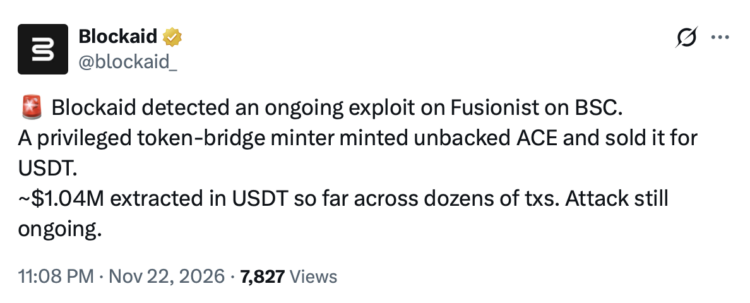
Security organization Blockaid highlighted the Fusionist bridge-minter vulnerability on November 22, summarizing the mechanism directly in its warning:
“
A privileged token-bridge minter minted unbacked ACE and sold it for USDT.
Blockaid · November 22 alert
Initially, the firm calculated that about $1.04 million had been siphoned off while the attack remained active. That figure served merely as an interim snapshot rather than a ceiling for the total damage.
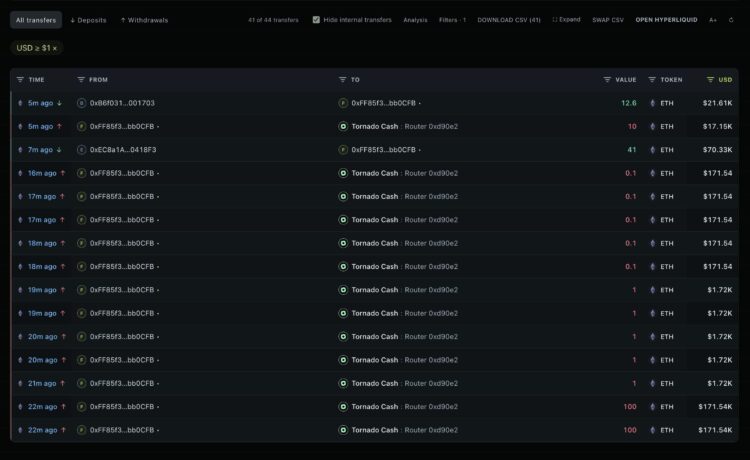
Blockchain surveillance profile Onchain Lens later noted that an assailant routed 1,091.5 ETH—equating to roughly $1.87 million at the time—through Tornado Cash. This observation tracks the movement of extracted funds rather than presenting an additional $1.87 million to stack on top of the initial theft estimate, as both values reflect different instances within the same suspected perpetrator’s cash flow.
Fusionist confirmed an ongoing ACE exploit affecting the BNB Smart Chain on Sunday, urging users to halt all transfers, trading, and bridging activities across that network. Based on reviewed records, the project has yet to release a reconciled accounting of losses or a technical post-mortem outlining how the authorized minting permissions were compromised.
Under normal operations, a token-bridge minter should only generate token representations when equivalent value is properly accounted for. Once minting privileges are improperly exploited, a blockchain can easily display completely standard-looking balances that possess zero actual backing.
This represents a familiar point of failure; NewsBTC previously covered a bridge-role incident involving unbacked asset creation at CrediX. While that past event does not pinpoint Fusionist’s exact root cause, it highlights why holding elevated bridge permissions creates such a critical security perimeter.
Traders Found a Second Exit Through Real ACE Reserves
The subsequent asset drain may ultimately carry more significance than the initial round of unbacked token creation.
According to SlowMist’s November 22 incident log, market participants purchased heavily discounted ACE generated by the supply disruption and utilized the cross-chain bridge to withdraw roughly 53.7 million legitimate ACE tokens from Endurance-side reserves. SlowMist calculated the value of these specific withdrawals at approximately $3.7 million.
Stripped of technical jargon, the mechanism functioned as follows: ACE tokens represented on the BNB Chain suddenly plummeted in value because unauthorized supply flooded the open market. A bridge that continued accepting those compromised tokens in exchange for genuine ACE on the Endurance network created an obvious arbitrage opportunity.
Any user capable of executing that conversion could swap cheap, devalued tokens for real ones. This trading window opened up simply because the underlying backing and the circulating supply tokens were no longer synchronized reliably.
The $3.7 million figure measures the total withdrawal of ACE reserves rather than proving every single recipient successfully cashed out those tokens for $3.7 million. Furthermore, it does not imply that every single trader participating in the exchange helped execute the minter compromise.
A distinct line exists between carrying out a security intrusion and trading across a platform whose defenses have already collapsed.
These nuances should not overshadow the underlying issue. A bridge can process transactions that appear technically valid while still yielding devastating economic consequences. When unbacked token supply can be redeemed directly for genuine reserves, safety checks have fundamentally failed.
Bithumb’s Monday Halt Shows How Far the Problem Travelled
Bithumb halted deposits and withdrawals for ACE early on November 23 before suspending trading altogether starting at 7:30 a.m. Korea time, as outlined in its subsequent security advisory.
In a translated version of its official Korean notice, the exchange stated that it had:
“
confirmed indications that abnormally issued ACE had entered cryptocurrency exchanges.
Bithumb · ACE security notice
The platform pointed to two specific transactions on the BNB Chain alongside a third related transaction.
While those transaction records serve as crucial investigative clues, a thorough independent analysis of the entire transfer path is still pending.
Bithumb used cautious phrasing, noting signs of abnormal supply entering exchanges rather than declaring that every single ACE token held in user accounts is fraudulent. The trading freeze acts as a protective measure rather than a final ruling on customer financial losses.
Nonetheless, this creates operational complications for token holders who never interacted with the bridge. Because tokens remain entirely fungible within trading markets, exchanges and project issuers require a reliable method for identifying compromised supply and determining how user balances, deposits, and trades will be handled moving forward.
The Real Security Question Is Why the Bridge Could Honor the Claims
It is easy to fixate entirely on the massive figures associated with the token minting. However, the far more critical question is what happened when those unauthorized assets came into contact with the bridge’s internal reserves.
A network does not need to lose full control of its core blockchain to experience a catastrophic failure within a single privileged smart contract function. Nor should a seemingly successful cross-chain bridge transaction ever be viewed as proof that the transferred asset possessed full backing.
Our assessment
The response cannot end with a pause notice and a promise to investigate.
Fusionist must clarify which minting permissions were compromised, whether those permissions have been successfully revoked, the exact volume of unbacked ACE created, how Endurance-side reserves were altered, and what financial claims remain open.
Exchanges require a workable plan for managing affected tokens, while everyday holders need transparency regarding whether a capital shortfall exists and who will bear responsibility for covering it.
A fair counterargument notes that the $5.7 million figure is an external projection, market valuations fluctuated throughout the incident, and the specific mechanics of the compromise remain unconfirmed.
SlowMist categorizes the event as a private-key leak, but this classification does not replace an official technical finding. Additionally, interpreting a precautionary exchange trading halt as definitive proof that every impacted customer experienced a loss would be premature.
These caveats alter how figures should be framed, but they do not diminish the severity of the bridge accounting failure.
The next necessary step is not a revived user interface or a comforting statement on social media. It requires a transparent reconciliation detailing the tokens minted, the reserves withdrawn, and the assets left to support legitimate ACE claims.
Until that information is provided, the estimated $5.7 million fallout serves as an ongoing warning regarding token security and the inherent risks of trusting bridge accounting systems.
Short FAQs
What caused the Fusionist ACE bridge exploit?
A privileged token-bridge minter minted unbacked ACE tokens on the BNB Chain, which were then sold for USDT and later used to drain genuine ACE reserves from the Endurance network.
What is the estimated financial loss from the incident?
According to SlowMist’s incident tracker, losses are estimated at approximately $5.7 million across two stages, though this is an unverified total.
Why did Bithumb freeze ACE trading?
Bithumb halted ACE deposits, withdrawals, and trading after discovering indications that abnormally issued tokens from the exploit had entered cryptocurrency exchanges.