
Justin Sun Launches Math Prize, Pledging Wealth Return
Justin Sun has launched the Justin Sun Prize, offering up to $1 million for machine-verifiable proofs of complex mathematical problems, with the inaugural top award going to OpenAI.

Geneva, Switzerland — September 16, 2026 — The Office of Justin Sun formally unveiled the Justin Sun Prize today, introducing a decentralized, zero-trust academic bounty framework grounded in a curated “problem list.” Focused on machine formal verification and breakthroughs in fundamental academic disciplines, the initiative offers up to US$1 million for a single problem solution, aiming to reshape scientific incentives for the artificial intelligence era and foster human-AI collaboration in fundamental research.
Alongside the launch, the inaugural winners of the Justin Sun Prize were revealed, highlighting formalized proofs and solutions spanning 66 distinct mathematical challenges. The top US$1 million award went to the OpenAI research team for solving and producing a formalized proof of the Three-Dimensional Navier–Stokes Existence and Smoothness problem. According to OpenAI’s disclosures, the underlying proof was generated by its internal model, while GPT‑6 Astra handled the Lean formalization and verification.
The Navier–Stokes equations, often abbreviated as N–S equations, model fluid motion and trace their origins back roughly two hundred years to contributions from French physicist Claude-Louis Navier, Irish-born British mathematician George Gabriel Stokes, and other researchers. The Clay Mathematics Institute previously designated the Navier–Stokes Existence and Smoothness dilemma as one of its seven Millennium Prize Problems in 2000, attaching a US$1 million bounty to its resolution.
Dispensing with standard credential requirements, traditional nomination procedures, and lifetime-achievement or four-year cycles, the Justin Sun Prize directly connects financial rewards to specific mathematical challenges and machine-verifiable formalized proofs. Any contributor who delivers the first qualifying breakthrough can claim the award.
Positioned as a potential “Nobel Prize of the AI Era,” the initiative seeks to modernize how scientific research and incentives are structured through decentralized, formalized, and machine-driven methods. The index of mathematical problems and its corresponding formalized code will undergo continuous public maintenance and updates. Once a problem enters the repository, it becomes permanently locked—entries can only be expanded, never deleted—and awarded funds are strictly non-refundable under any circumstances.
Current listings already incorporate formalized verifications for the Poincaré Conjecture, the Riemann Hypothesis, Goldbach’s Conjecture, and numerous unsolved problems originally posed during the life of the late mathematician and Wolf Prize laureate Paul Erdős.
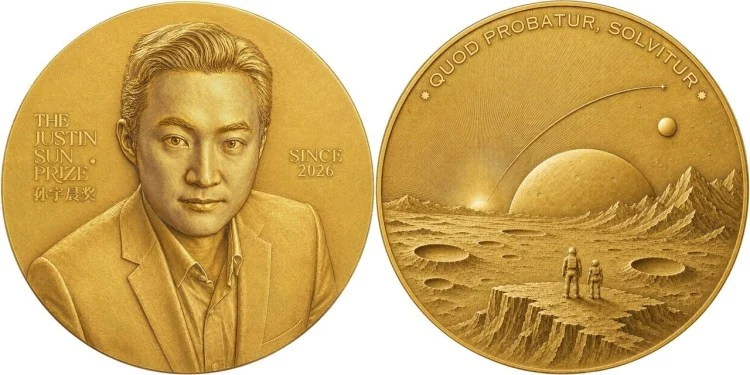
Along with the financial reward, laureates receive a medal and a certificate. The rim of the medal features the Latin inscription “Quod probatur, solvitur,” which translates to “Proved, then paid.”
The Justin Sun Prize operates under three foundational tenets: public benefit, openness, and open-source transparency. It welcomes contributions from all eligible parties without regard to nationality, institutional affiliation, or identity, drawing no distinction between human and artificial intelligence contributors. Financial resources are dedicated exclusively to prize payouts and open initiatives rather than profit generation. Furthermore, the problem list, verification criteria, proofs, and related materials are published openly via GitHub, while disbursement records remain permanently traceable and immutable via on-chain tracking.
“An award named after a person is the least political thing in the world,” Sun remarked. “More importantly, it gives me an answer to myself—my wealth is rooted in mathematics. It came from mathematics, and it will return to mathematics.”
Public records indicate that Sun has contributed upwards of US$45 million toward technology, disaster relief, environmental protection, and other sectors. The Justin Sun Prize is set to become a focal point of his philanthropic work, sustaining fundamental scientific advancements through a verifiable and open structure.
Prizewinners can receive disbursements in either USDT on TRON (TRC-20) or USDC on Ethereum (ERC-20), depending on their preference. Additional details are available at www.hejustinsun.com/prize.
About the Office of Justin Sun
The Office of Justin Sun manages Justin Sun’s global philanthropic, business, and public endeavors across blockchain, technology, artificial intelligence, scientific research, investment, space exploration, and the arts.
Justin Sun is the founder of TRON and served as the Ambassador and Permanent Representative of Grenada to the World Trade Organization. TRON functions as a prominent blockchain supporting the stablecoin ecosystem, handling over $13 trillion in transaction volume since its launch. Populations across emerging global markets depend on USDT on TRON for access to the international financial system.
As a protégé of Alibaba founder Jack Ma, Sun has earned international recognition within the digital asset space, highlighted by a Forbes cover feature in April 2025 and multiple berths on the Forbes 30 Under 30 roster. He traveled to space in August 2025 aboard Blue Origin’s NS-34 flight, making him the 712th spacefarer in history. His broader pursuits encompass gaming, investment, technology, philanthropy, art, and space exploration.
Office of Justin Sun Contact:
About Justin Sun Prize
Established by Justin Sun, the Justin Sun Prize is an academic program designed to champion advancements in mathematics, machine verification, and AI-driven scientific discovery. The decentralized prize evaluates mathematical work purely on the rigor, strength, and verifiability of the proof itself, bypassing the submitter’s personal prestige or institutional reputation.
Sun founded the award in his own name to reflect a long-term pledge to channel wealth generated through technology and mathematics back into the mathematical discipline. The legacy of the prize will rely on the validity of the work it honors and the breakthroughs that withstand scrutiny over time. By linking precise mathematical hurdles to machine-verifiable proofs, the prize prioritizes open-source access, openness, and public benefit.
Additional information can be found at https://www.hejustinsun.com/prize.
Contact:
thejustinsunprize@hejustinsun.com
Short FAQs
What is the Justin Sun Prize?
The Justin Sun Prize is a decentralized, zero-trust academic bounty mechanism established to reward breakthroughs in fundamental scientific disciplines and machine formal verification, with top prizes reaching up to US$1 million.
Who won the top prize in the inaugural announcement?
The OpenAI research team won the top US$1 million prize for their solution and formalized proof regarding the Existence and Smoothness of the Three-Dimensional Navier–Stokes Equations.
How are the winning proofs verified and paid out?
Submissions rely on machine-verifiable formalized proofs (such as Lean formalization). Prizes are distributed in USDT on TRON (TRC-20) or USDC on Ethereum (ERC-20), with disbursement records tracked immutably on-chain.
Are there eligibility barriers based on nationality or institutional identity?
No. The prize adheres to principles of openness and is accessible to all eligible contributors without restrictions based on nationality, institution, or identity, treating human and AI contributors equally.